Andreas Jäger reports on Klimabeton
January 26, 2023
Concrete as a climate saver?
One thing is certain: turning off all sources of CO2 to save the climate is not enough - we will also have to actively remove our CO2 waste from the air in future. The fact that the "climate sinner" concrete, of all things, can help us to do this could be a step-by-step joke in climate history. From Saul to Paul: How a source could become a sink.
Dear roommates!
We have two options for actively removing the greenhouse gasCO2 from the air: Firstly, we try to captureCO2 from the air using complicated and energy-intensive processes and then inject it into old gas and oil reservoirs. The downside is that we first have to develop these processes and scale them up to the right size. (After all, we are talking about several gigatons ofCO2 per year that we will have to remove from the air). Or, as a second option, we can let nature help us. From trees, bushes, hedges, grasses, wheat, corn, ... - simply from everything that grows and thrives.
The principle
We let all these plants take carbon dioxide (CO2) out of the air and bind the carbon - and then we prevent the carbon from escaping back into the air (spoiler alert: by turning it into biochar). In principle, just as millions of years ago primeval forests became coal deposits. This is not science fiction: charcoal burners, who make charcoal from wood in their charcoal kilns, have mastered the technique for thousands of years. And like the charcoal burners, we let the plants make the difficult start: they convert gas into sugar - photosynthesis converts the gaseousCO2 into solid C6H12O6.
The plants make the start
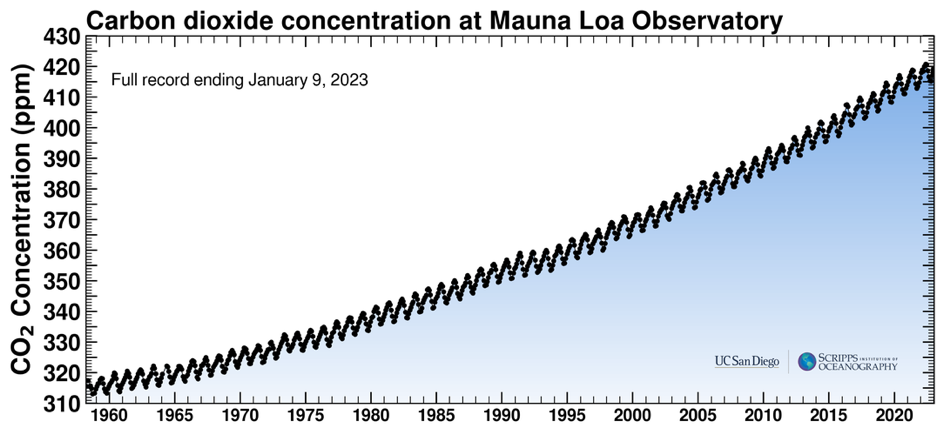
Whether leaf, stem or branch - carbon that the plant has previously taken from the air is stored in all types of biomass. Carbon that has previously been whizzingthrough the air in combination with oxygen as the greenhouse gasCO2 . In addition to water and sun, this carbon dioxide is an indispensable staple food for plants, which they need for photosynthesis. This is the only way they can grow and is what makes the famousCO2 curve of Mauna Loa in Hawaii a sawtooth curve, for example. When the vegetation in the northern hemisphere takes off in spring, the plants grow at the expense ofCO2 and eat a dent in the curve. In the fall, when the plants rot again, the greenhouse gas returns. In this way, year after year, the world's plants file a tooth into the overall risingCO2 curve.
Now it's our turn - pyrolysis
After the plants have done the difficult part, namely binding the carbon in theCO2, it's our turn: we have to convert the carbon in the biomass into as pure a form as possible, like graphite or diamond. We do this with fire, but it is important that we keep the fire small by undersupplying it with oxygen and allowing it to smoulder. The resulting heat breaks the molecules apart and some of the carbon combines - due to the lack of oxygen - to form plant carbon. In the case of wood, the smouldering fire turns into charcoal, as charcoal burners have been doing in their kilns for thousands of years. In principle, it is like a match: what remains at the front as a skeleton after the "bad" because oxygen-poor combustion is charcoal with approx. 50% pure carbon. The process is technically called pyrolysis and in modern, technically sophisticated pyrolysis ovens, the charcoal produced can consist of up to 90% pure carbon.
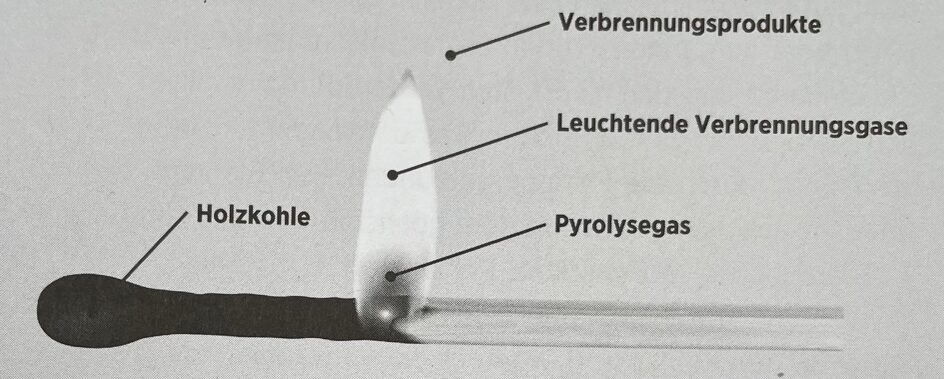
The black skeleton produced when a match burns is approximately 50% pure carbon. In a pyrolysis plant, up to 90% pure carbon is possible. Graphic from: "Cool Down - Solving the climate crisis with biochar?", Albert Bates, Kathleen Draper, oekom
To put it bluntly
Of course, this "sloppy" combustion - pyrolysis - releasesCO2 when the most volatile carbon compounds are gasified in the heat and burnt to ash. Up to this point, the smouldering fire is a completely normal source of the greenhouse gasCO2. For some of the carbon, however, there is not enough carbon dioxide to burn. So the atoms combine to form highly pure carbon. This is the actual pyrolysis.
The bottom line - and this is the point - is that around 25% of the carbon (which was initially in the match) is bound as charcoal. We have therefore removed net carbon dioxide from the atmosphere.
Biochar - the new black gold
The ingenious thing about biochar is that it is very stable; inert, as the chemists say. Bacteria cannot digest the charcoal because they are unable to break up the carbon atoms that are bonded together and use them for themselves. Chemically speaking, they are reluctant to exchange the carbon atoms with other reaction partners. This brings us to an important point: We have turned the volatile carbon in the greenhouse gasCO2 into a solid, stable and relatively pure form of carbon. If the starting material for pyrolysis is wood, we speak of charcoal. If it is generally biomass that is "carbonized", for example straw, we speak of biochar.
Now things are really taking off. The use of this biochar is currently being intensively researched and many possibilities are emerging. One major topic is agriculture. Biochar is used to improve soils, as the Indians have done for centuries with Terra Preta in the Amazon. The other major topic - and this is what we are talking about here - is the use of biochar in the construction industry.
Green concrete with biochar
We are in the midst of a global construction boom. The number of buildings in the world is set to double by 2060. The process of burning limestone (CaCO3 -> CaO +CO2) in particular releases a lot ofCO2. More than 500 kg of greenhouse gas is produced per tonne of cement. As 90% of all buildings are made of concrete and steel, the construction industry is a huge source of greenhouse gases.
In order to make concrete climate-neutral or even climate-positive, biochar is mixed into the concrete as an additive or, even better, part of the cement is replaced with biochar. This not only means that less cement has to be burned, which already savesCO2. In addition - and this is the greater effect - this biochar is also a carbon store with aCO2 factor of three: for every kilo of biochar stored in the concrete, approx. 3 kilos ofCO2 are removed from the air. If you add to these two effects (cement replacement and storage effect) the natural recarbonization of the concrete, concrete can even become climate-positive, i.e. store more carbon than is released during its production.
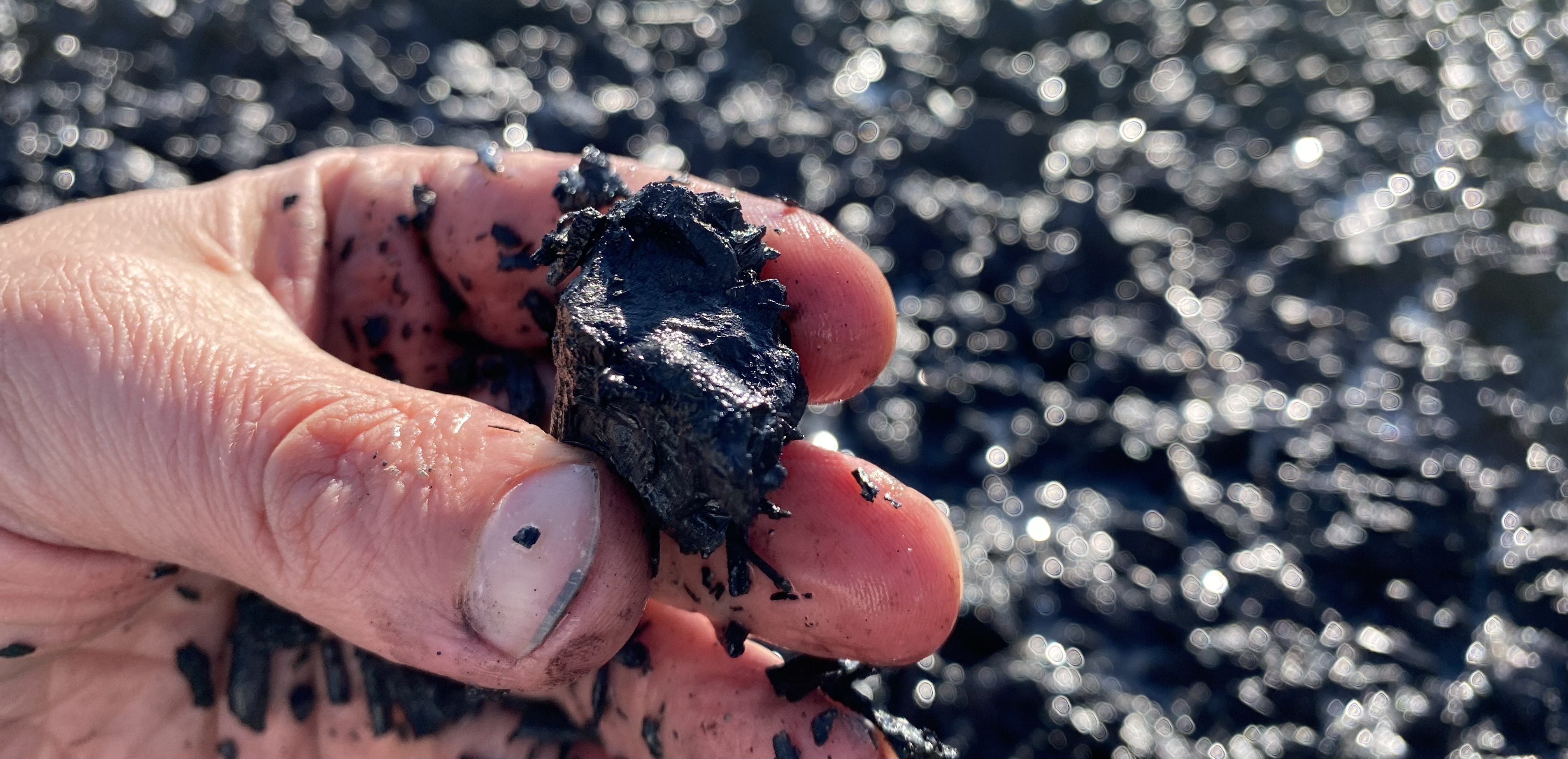
A piece of charcoal made in a Kon Tiki oven from dead vines in a vineyard in Lower Austria. The technique of "charcoal burning", i.e. the production of charcoal - i.e. biochar from wood - is thousands of years old. This technique has been refined and in modern pyrolysis ovens, charcoal with up to 90% pure carbon can be produced.
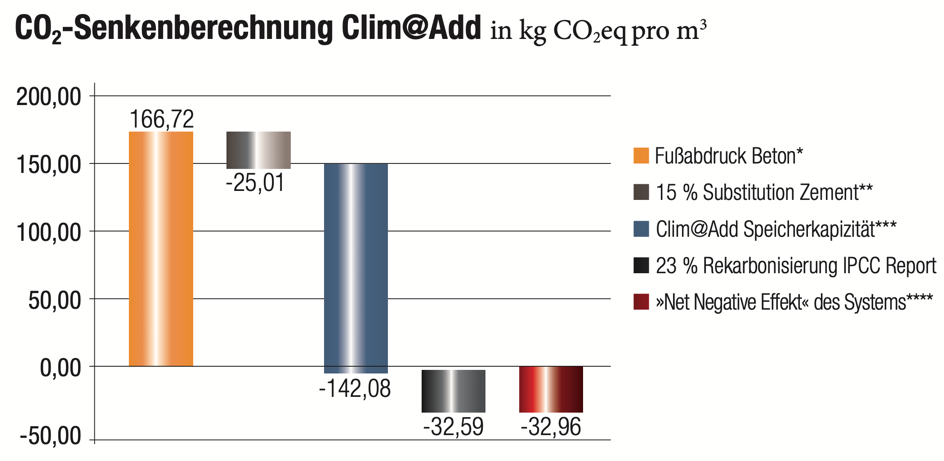
CO2 balance of concrete when using the certified green carbon Clim@Add according to the manufacturer SYNCRAFT: -25kgCO2eqperm3 savings through 15% less cement, -142.08 kg in the biochar, -32.59 kg through recarbonization. In total, this results in: -32.96 kg of storedCO2eqperm3 of concrete.
This is already being implemented in practice, such as in 2022 on the new ÖBB technology building in Bregenz/Vorarlberg: the footprint of conventional concrete is 174 kgCO2eqper cubic meter. With the processed concrete volume of 109.7m3, this would be approx. 18 tons ofCO2 in normal production. By adding biochar as an aggregate, 8.58 tons of this could be saved, thus avoiding 47% of the amount of greenhouse gas normally released into the atmosphere. If one is more courageous and also replaces part of the cement with biochar, the remaining 53% could also be saved.
This is already being implemented in practice, such as in 2022 on the new ÖBB technology building in Bregenz/Vorarlberg: the footprint of conventional concrete is 174 kgCO2eqper cubic meter. With the processed concrete volume of 109.7m3, this would be approx. 18 tons ofCO2 in normal production. By adding biochar as an aggregate, 8.58 tons of this could be saved, thus avoiding 47% of the amount of greenhouse gas normally released into the atmosphere. If one is more courageous and also replaces part of the cement with biochar, the remaining 53% could also be saved.
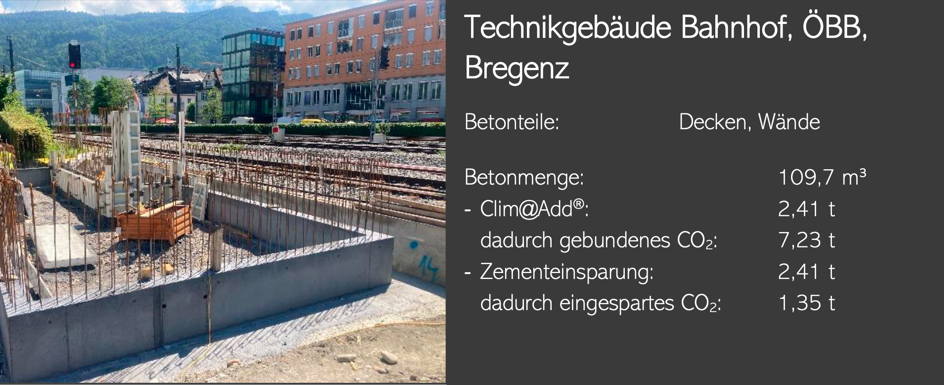
Practical example of ÖBB technical building, completed in 2022: By adding biochar, 47% of theCO2 emissions that normally occur could be saved.
The storage effect using the example of a precast concrete staircase in Dornbirn, also installed in 2022, is impressive: 1.81m3 of staircase concrete would normally pollute the atmosphere with 312 kg ofCO2. By adding 108 kg of biochar, 324 kgof CO2eqcould be bound. That is a saving of just over 100%, making this staircase climate-neutral.
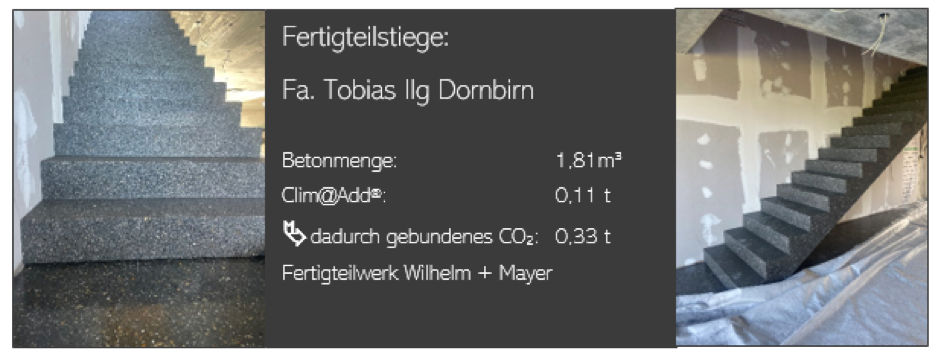
Practical example of a prefabricated staircase by Tobias Ilg in Dornbirn, completed in 2022: By adding 108 kg of biochar, just over 300 kg ofCO2eq are stored and the staircase is climate-neutral.
Climate-positive concrete: how the source ultimately becomes a sink
However, the potential of the method is far from exhausted. The vision is that the CO2 source of concrete should not only dry up, it should even become a sink. The lessCO2 cement can be burned in the future - and there are still reserves, especially in terms of fuels - the more effective the replacement of cement with biochar will be. Soon the storage ofCO2 will far outstrip the production, then more will be stored than is emitted - this will be the green storage concrete that helps to save the climate.
In summary, the path we should take is mapped out: We generate green carbon by burning waste wood, straw and other biomass. We incorporate these into concrete and thus remove ourCO2 waste from the atmosphere, building by building. From photosynthesis to pyrolysis to concrete production, everything is known and technically feasible - we just have to follow the path.
Dear housemates, let's just do it!